Vox.com’s most recent “explainer” on Yemen is a prime example of what casual analysts get wrong about the county and why Vox’s brand of explanatory journalism, while great in principle, suffers from its reliance on a handful of generalists jumping from subject to subject, portraying themselves as experts capable of laying down the “real truth” behind any current event.
Vox’s first error is especially egregious: they describe the Southern Movement (Hirak) as led by Al Qaeda in the Arabian Peninsula.
“There’s a whole other rebellion in Yemen’s south, which is led by a particularly dangerous al-Qaeda affiliate, Al-Qaeda in the Arabian Peninsula (AQAP).”

The “rebellion in Yemen’s south” presumably refers to Hirak, the name used to refer to a protest in the former South Yemen advocating for separation from Sana’a, either through increased autonomy or outright secession. Associating Hirak with AQAP is especially cringe-worthy given how much the south has suffered at the hands of other militant jihadists. It’s was a group of Afghan jihad veterans who ransacked Aden during the South’s previous failed attempt at secession in 1994.
Vox conflating Hirak with AQAP likely comes from the fact that AQAP and its alter ego Ansar al-Sharia took over a chunk of southern territory after the popular protests of 2011. AQAP’s territorial control was concentrated in the former-South Yemen governorates of Lahj and Abyan, including Abyan’s capital Zinjibar. This sparked Western media hyperventilation over the possibility of al-Qaeda overrunning Aden and somehow holding hostage the world’s oil supplies transiting through the Bab al-Mandab strait, which lasted until locally-organized popular committees and a U.S.-supported military campaign expelled AQAP from their self-declared emirate.
Thirty more seconds of Googling could have cleared up the AQAP-Hirak confusion for Vox, so while embarrassing, this mistake isn’t the kind of pervasive shortcoming that undermines a good deal of Yemen analysis in other outlets.
The more insidious analytical problem with Vox’s piece, and those of most media outlets, is the casual description of the Yemeni government as “Sunni-dominated” and the conflict as primarily sectarian. Wire services like Reuters made a particularly bad habit of this in 2014, describing the Houthis as “Shi’ite rebels” fighting “Sunni” northern tribesmen, though they are traditionally Zaydi.

The sectarian lens is an easy analytic framework to fall back on. It has stuck in Yemen because some of the basic facts on which this analysis rests are true: Shi’a (most of whom are Zaydi) are a slight minority in Yemen (around 40%). The president is Sunni (Shafi’i). Zaydi religious leaders have been oppressed by Sana’a since the 1962-1970 civil war succeeded in replacing the Zaydi Imam with a republican form of government.
While sectarian analysis is convenient, it is wrong in the Houthi case. Intentionally or not, it implies that Sunni-Shi’a sectarianism in Yemen should be analyzed similarly to the Sunni-Shi’a divide in Iraq or Syria. But the northern tribesmen who fought the Houthis throughout 2014, though affiliated with the Islamist Islah party, are from traditionally Zaydi tribes. Former president Ali Abdullah Saleh, who fought the Houthis in multiple wars throughout the 2000s, is also a Zaydi. In fact, Saleh initially had no problem with the early Houthi movement (the Believing Youth) as it offered a counterbalance to Salafi influence in the north.

The Houthis are not fighting the “Sunni-led” government so much as they are just fighting the government. Their long march and consolidation of power in northern Yemen, which has been underway for years, is best understood as a re-balancing among northern power centers rather than a mission for revenge against sectarian crimes or religious oppression. Players in the north include the Houthis, tribal confederations, and government forces.
The most sectarian of any of the Houthi’s battles is its fight with Salafis, whom they’ve long seen as a threat to Zaydi youth and a sign of Saudi interference. The Houthi campaign for northern domination began with their siege of the Wahhabi Dar al-Hadith institute in the northern town of Dammaj.
Beyond this, the sectarian motivation is harder to back up. Their next targets were tribes affiliated with Islah, particularly the Al-Ahmar-led Hashed tribal confederation. While the Islah connection supports a casual sectarian association given Islah’s philosophical roots in the Sunni Muslim Brotherhood, the tribes supporting Islah in the north were historically Zaydi. Their alliance with Islah could be understood as political rather than religious. The Houthi-tribal conflict is better read as a re-balancing of power; the (non-sayid) Zaydi tribesmen, from whom the sayid-led Zaydi Imamate drew its foot soldiers, were politically empowered when Zaydi sayids (who form the Houthis’ ideologic core) lost political influence after the 1962 revolution. Now the Houthis have seized on an opportunity to reassert their control.
Once the Houthis defeated the Al-Ahmars in 2014, the next target was the Sana’a-based government. But the “Sunni-dominated” government’s roots are not in Sunni triumphalism but a non-sectarian Free Officer republicanism, however flawed. The republican government may have been anti-monarchy, but it was not anti-Zaydi. Saleh, Yemen’s president until 2012, was himself a Zaydi. Yet he fought six wars against the Houthis. Using the sectarian convention, that would mean Yemen’s “Shia-dominated” government fought the Houthi “shi’ite militia.” Sectarian analysis falls apart.
Moreover, the Houthis have enjoyed support from individuals across sectarian lines since the 2011 protests. The have gained the support of anti-establishment protestors, even Sunnis, who feel betrayed by the internationally-backed National Dialogue’s shortcomings and are encouraged by the Houthis’ willingness to challenge tired, old-guard players like president Hadi (Saleh’s vice president for 17 years) and the al-Ahmar family.
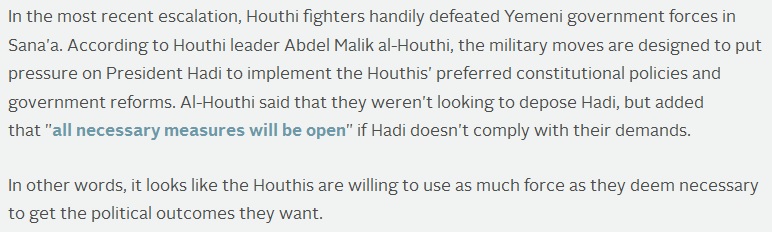
What Vox does get right, however, is its tempered appreciation of Houthi goals. Despite widespread talk of a coup, it appears the Houthis prefer to use their power to influence the government, not usurp it. Long critics of the National Dialogue, the Houthis seem particularly concerned this time about the new constitution’s redrawing of federal districts to bi-sect traditional Houthi territory will diminish their ability to protect their interests in Yemen’s future federal reformation.
 Filseyni