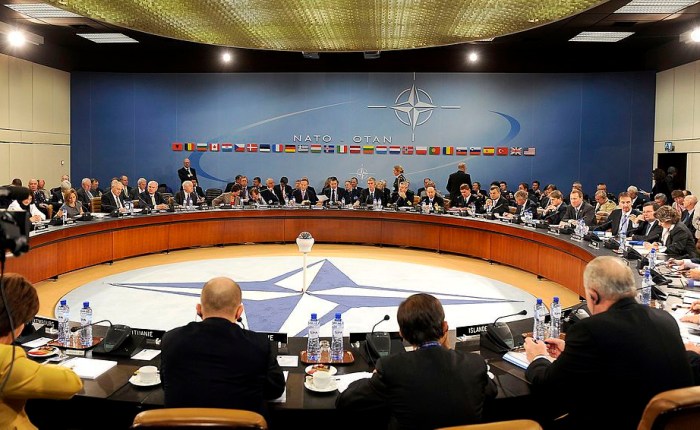
Politico recently reported that NATO was considering joining the coalition fighting the Islamic States in Syria (presumably hoping that this would lead American president Donald Trump to dial back his NATO skepticism):
NATO has labeled the May 25 session a meeting, not a summit, and will hold only a dinner to minimize the chances of a Trump eruption. Leaders have been told to hold normally windy remarks to just two to four minutes to keep Trump’s attention. (“This is routine,” the NATO spokesperson said.) They are even preparing to consider a “deliverable” to Trump of having NATO officially join the U.S.-led coalition fighting the Islamic State in Syria, as Trump has said his priority is getting NATO to do more in combating terrorism. “It’s a phony deliverable to give to Trump, a Twitter deliverable,” said a former senior U.S. official, pointing out that the individual NATO member states are already members of that coalition.
I wrote a short paper two years ago for grad school exploring whether NATO should intervene in Syria against the Islamic State. Since the paper is topically relevant again, I’ve decided to post it here in full. As it was written in 2015, some of its references and analysis may be dated. I’ve lightly edited it for clarity and for publishing in a blog format (for example, I turned citations in hyperlinks, footnotes into parenthetical asides, etc.).
In it I argued against a NATO intervention. NATO is not prepared to begin another intervention that would require decade(s) of nation-building efforts and post-conflict security, in addition to the Afghanistan intervention it is still struggling to conclude. Adding a Syrian intervention to the mix would leave NATO states’ armed forces strained. NATO resources would be better applied to its traditional mission of defending Europe from Russia, a threat that’s reemerged over the past half-dozen years. Most of NATO’s member states are already a part of the U.S.-led coalition fighting the Islamic State in Syria in any case. Since the primary threat to Europe from the Islamic State is terrorism, I advocate instead for member states to increase domestic law enforcement resources to surveil potential threats, improve intelligence sharing with allies, and tighten restrictions on European travel to Syria – a step that especially requires Turkey’s cooperation.
####
Should NATO Intervene Against ISIS?
An Appraisal of the Limits and Possibilities for NATO Intervention in the Syria Conflict
May 2015
Spill-over from the four-year-old conflict in Syria threatens NATO’s European members. Turkey is the most directly affected, as skirmishes in northern Syria have occasionally affected Turkish border towns. NATO’s southeastern flank is not the only point of vulnerability. In fact, “flank” is not the right concept with which to describe the geography of the threat, particularly from ISIS (The Islamic State in Iraq and al-Sham, now calling itself simply the Islamic State). According to Europol, over five thousand citizens of European countries have traveled to fight in Syria. Their return to their countries of origin, scattered throughout Europe, brings an increased risk of terrorism and religious violence to Europe’s interior. Unlike veterans of the 1980s jihad in Afghanistan who waited for later conflicts like Bosnia to emerge before fighting again, the new generation of jihadist is encouraged to undertake their own attacks as soon as they return home. Moreover, ISIS’s success can inspire sympathizers in the West to skip traveling to Syria altogether and to execute acts of terror at home, such as an attack on a synagogue in Copenhagen earlier this year.
Since ISIS poses a security threat to NATO member countries, NATO must consider what role it can and should play in countering it. After reviewing the types of interventions NATO has undertaken since the end of the Cold War, its success in executing them, and the nature of the Syrian conflict of which ISIS is a part, it becomes clear that NATO’s role in a direct intervention should be minimal. Rather, NATO capabilities will be best used to support the countries most directly affected by the conflict, like Turkey. The main focus of counter-ISIS efforts under the NATO umbrella should be the creation of linkages with EUROPOL and other law enforcement agencies whose purview looks across the European continent, better enabling them to identify, monitor, and apprehend returning fighters.
What a NATO Intervention Looks Like
NATO interventions since the Cold War have followed three broad models. The first is coercive diplomacy, in which NATO uses air power to compel a conflict’s belligerents to accede to a political resolution constructed through intensive diplomatic efforts running in parallel to the military intervention. NATO or the UN then sends peacekeeping forces to provide post-conflict security and seeks to control post-conflict politics. The two Balkan conflicts typify this model. The second model pursues the direct destruction of the sitting government in the hostile state, followed by the construction of a new, democratic state and reformed security services more favorable to the allies’ interests. NATO’s International Security Assistance Force (ISAF) and Resolute Support missions in Afghanistan, as well the U.S. missions Operation Enduring Freedom (OEF) and Operation Freedom’s Sentinel, also in Afghanistan, follow this model. The third is the “light footprint” model, in which NATO supports a preferred belligerent with airpower and arms, but provides few or no conventional ground forces of its own. The post-conflict politics are left largely in the hands of domestic actors—there are no peacekeeping forces or high commissioners—although NATO governments may provide limited technical support through aid organizations or NGOs such as the National Democratic Institute or the National Endowment for Democracy. NATO’s intervention in Libya typifies this model.
NATO has executed these three models to various degrees of success (or lack thereof). The coercive diplomacy missions in the Balkans were the most successful, with relative stability lasting to the present. In Afghanistan, the United States succeeded in removing the Taliban from power, but NATO’s nation building mission has left much to be desired. Corruption has been an endemic problem inside the Afghan government and aid efforts have been marked by waste and poorly designed programs. Afghan police training only now seems to be getting on the right track, although the quality of police units remains uneven, management of police pay remains dogged by reports of corruption, and unsupervised, remotely located police bases have been known to abuse local populations. The situation may finally be trending in a positive direction now, with a new government led by Ashraf Ghani and the Afghan National Army taking the lead on internal security. However, it has taken over a decade of conflict, hundreds of NATO fatalities (thousands if counting American lives lost in Operation Enduring Freedom), and billions of dollars spent to reach this point of mixed results. In Libya, NATO achieved its stated goals: it protected the population of Benghazi from a potential government-led massacre and the NATO-backed rebels toppled the murderous Qaddafi regime. However, the post-conflict political situation deteriorated into a new civil war, revealing the light footprint approach’s limited ability to achieve sustainable success. Today, Libya still represents a threat to NATO’s southern flank as NATO members cast a concerned eye on the growing jihadist presence in the country and struggle to deal with refugee flows between the African continent and Europe’s Mediterranean border, which the failure of the Libyan state exacerbates and facilitates.
A Hypothetical Intervention against ISIS
Unfortunately for NATO, its most successful intervention model—coercive diplomacy—is not appropriate for dealing with ISIS. ISIS is not the kind of actor that will respond to diplomatic negotiation efforts, coerced or otherwise. Domination of the entire Muslim world is baked into its ideology, as is hatred to the point of enslavement or execution for religious minorities and even Sunni Muslims who do not accept ISIS’s violent, exclusionary ideology. Nor is ISIS responsive to “realist” incentives and motivations. A more calculating organization might have forgone beheading Western journalists and enslaving Yazidi women to avoid the negative Western military attention such brutality would bring. ISIS carried out these atrocities anyway, signaling there is no ground for sticks (and especially not carrots) with which NATO could achieve any diplomatic resolution.
The Libyan “light footprint” model might be more successful. NATO could support an anti-ISIS faction in Syria’s civil war, train and equip it, and provide air cover for its operations. The challenge is that there are no good candidates to support. The Free Syrian Army is currently working with anti-ISIS extremist groups whose ideologies should make NATO governments extremely apprehensive (for example, the Free Syrian Army is reportedly participating in the Jaish al Fatah coalitions, which include the Islamist militia Ahrar al-Sham and the terrorist-designated Al Qaeda affiliate Jabhat al-Nusra). NATO members like the United States have long and successful relationships with Kurdish militias, but supporting them to the level required to fully oust ISIS involves a number of problematic consequences. Turkey, a NATO member, would have a hard time permitting empowerment of Kurdish militias beyond current levels. Baghdad, which individual NATO members are trying to shore up through Operation Inherent Resolve, would have its own strong reservations. Iran-backed Shi’a militias are also vehemently anti-ISIS. Though their contribution to anti-ISIS efforts in Iraq might be tolerated now, formally backing them is out of the question for obvious geopolitical reasons, as well for their assured inflammation of already-high sectarian tensions. The United States is currently trying to develop its own faction of fighters with vetted backgrounds, but the program has been extremely slow to develop as American policymakers disagree on vetting procedures, especially on what level of past militant involvement to tolerate. If a Syrian fighter has survived to this point in a brutal, grinding civil war, he is most likely not as clean as Western governments would like and has most probably, if only out of necessity, at times worked with groups NATO members would deem unacceptable.
Even if NATO could somehow find a faction worthy of its support and capable of dislodging ISIS, it would face the same problem that resulted in Libya: tumultuous post-conflict politics. To make matters worse, hunting ISIS’s remnants would be a years-long process. Moreover, the various anti-ISIS factions active in the Syrian civil war have immense disagreements over how freed territory should be governed. Some are Islamist, others are more favorable to democracy, and even those that support democratic governance would not necessarily support liberal democratic governance. History suggests this period would be subject to serious infighting among the victorious anti-ISIS coalition of militias, and this fractious coalition would still have to face the Assad-led rump-state in western Syria.
What a decisive victory against ISIS requires, if NATO were to intervene directly, is an intervention more in line with ISAF’s mission in Afghanistan. The ISIS “government” would need to be dislodged and destroyed. An international security force would need to keep post-conflict order and hunt down ISIS’s remnants. In the Syrian portion of former ISIS territory—assuming the international community would rather carve out a new state than press on to defeat the Assad government and reunite all of Syria within its presently recognized borders—immense international aid would be required both to build new governing institutions and to rebuild the cities and infrastructure destroyed by the civil war.
The Iraqi portion of former ISIS territory could conceivably be returned to Baghdad, although this would incur the risk that Shi’a Iraqi militias would exact retribution on the Sunni population who supported ISIS (even though some did so out of fear). This would only increase the sense of Sunni alienation and disillusionment with Baghdad that led many Sunnis to cast their lot with ISIS in the first place. Partition of Iraq might be proposed, as could Kurdish independence or further increases in Kurdish autonomy, but these paths are fraught with their own complications. Baghdad would resist vehemently. Turkey would do all in its power to avoid an independent Kurdish state.
Even if these complications could be resolved, NATO simply does not have the resources to undertake such a massive mission in Syria now. NATO is still working hard to consolidate fragile, incremental gains in Afghanistan. In addition, the reemergence of an aggressive Russia is now the more existential threat to Europe. NATO’s mission to protect Europe is best served by focusing on the Russian threat. Inserting itself in the jihadist milieu that is eastern Syria and undertaking a potentially decade(s)-long rebuilding mission would only distract attention and divert resources from Europe’s more pressing challenge to the East.
The best kinetic solution is perhaps the one coalition forces, including many NATO members, are already enacting through Operation Inherent Resolve. In this operation, a coalition of Western and Arab states is harassing ISIS targets from the air and destroying weapons stocks, oil refineries, “government” buildings, and exposed fighters. Ideally, ground forces would clean up behind the air strikes but coalition forces are understandably unwilling to take on that burden themselves. The goal is to degrade and harass ISIS, heading off further territorial expansion and weakening its grip on the territory it now holds.
What NATO Member States Can Do
Since directly intervening against ISIS beyond individual NATO members’ current participation in Operation Inherent Resolve is not in NATO’s best interest given resource constraints and more pressing threats, NATO should instead help European states deal with the conflict’s symptoms. Chief among these is the flow of European fighters to and from the conflict and the threat of ISIS-directed or ISIS-inspired terrorism, especially from those who fought with ISIS and other jihadist groups. Such a problem is best handled by intelligence agencies and law enforcement, but NATO can lend its intelligence to the fight—particularly information on European fighters gathered by member states through their actions under Operation Inherent Resolve. Mechanisms to share relevant information gathered on European citizens who have traveled to Syria and those who have potentially returned with EU law enforcement agencies such as Europol should be established, enabling them to monitor, track, and detain potential threats. Intelligence sharing is especially important given the open borders among EU members.
Rather than ratcheting up public spending to support a Syrian intervention, NATO member states would do well to use those resources to better fund and equip domestic law enforcement agencies and surveillance capabilties. The perpetrators of recent attacks in Europe (the Charlie Hebdo attackers for example) were known to authorities and at times had been previously surveilled and even detained, but a lack of resources and manpower meant surveillance could not be maintained if the suspects went for long periods without raising additional red flags or undertaking further suspicious activity.
NATO members should also advocate for a unified policy among member states regarding citizen travel to Syria and key transit countries like Turkey. This could include banning travel to Syria with a restricted set of exceptions for aid workers, family, and other permissible travelers. Turkey can play an essential role by tightening control over access to border towns with Syria and notifying other European states when their citizens turn up in suspicious places. NATO members can provide technical assistance to Turkey to help it tighten its border security. Additionally, NATO members should pressure Turkey to reduce its support for Islamist militias in Syria (for example, leaders of the Jaish al Islam coalition are reported to have met Turkish officials in Turkey).
ISIS and the broader Syrian conflict pose real challenges to European security. However, intervening directly in the conflict is not the best use of limited NATO resources. ISIS would not be responsive to coercive diplomacy, and a light footprint approach suffers from the lack of an appropriate faction to back. An ISAF-style intervention is the only model that could decisively eliminate ISIS, but the amount of resources, time, and lives such an intervention would cost are not commensurate with the threat ISIS poses to Europe relative to Russia, from which such an intervention would divert attention. Therefore, NATO is not the best auspices through which to address ISIS. Interested member states should instead channel their efforts through Operation Inherent Resolve. With regard to ISIS, NATO should instead contribute substantial intelligence support to NATO and EU members and take steps to shore up Turkey’s will and ability to control its border. Intelligence support will help minimize the threat posed by European fighters returning from the Syrian conflict by enabling European law enforcement agencies to better monitor, track, and apprehend returning fighters who fought with ISIS and other terrorist groups.
Header Photo: NATO headquarters in Brussels, Belgium, Oct. 14, 2010 (Credit: public domain)

 Filseyni
